Nigeria’s Eight Athletics Records That Have Defied Time
For the last four years, Nigerian athletics has been a demolition site, with a new generation of athletes tearing down national records that had stood for decades.
Kayinsola Ajayi, Samuel Ogazi, Ezekiel Nathaniel, Favour Ofili, Ese Brume and Tobi Amusan are among those who have helped rewrite the country’s record books, ending the reign of several benchmarks established by earlier generations.
But eight national records remain untouched, including marks set more than four decades ago.
They range from Ajayi Agbebaku’s 17.26 metres in the men’s triple jump, established in 1983, to Chukwuebuka Enekwechi’s 72.77m in the hammer throw, set in 2015.
Some have survived because of the exceptional performances that produced them. Others reflect Nigeria’s struggle to maintain a competitive presence in particular disciplines.
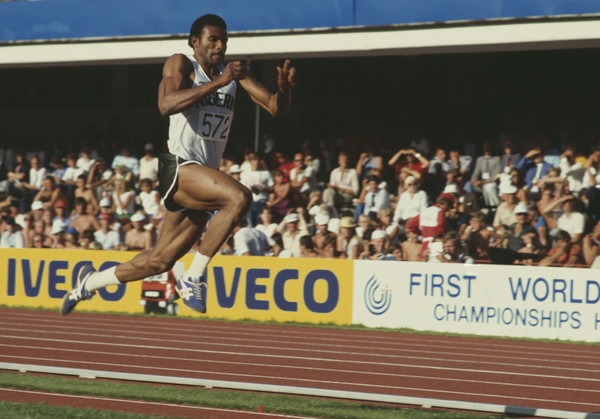
Agbebaku’s men’s triple jump record is the oldest surviving mark on the list. He leapt 17.26m to win gold at the 1983 World University Games in Edmonton, Canada, on July 8.
A month later, he jumped 17.18m to claim bronze at the inaugural World Championships in Helsinki, becoming Nigeria’s first individual medallist at the global championships.
Only two Nigerians have subsequently jumped beyond 17.20m. Joseph Taiwo recorded 17.22m in 1988, while Tosin Oke reached 17.23m in 2012, coming within three centimetres of Agbebaku’s national record.
The men’s long jump record has also resisted successive generations. Yusuf Alli set the Nigerian mark of 8.27m at the African Championships in Lagos on August 8, 1989.
A three-time Olympian and Commonwealth Games champion in Auckland in 1990, Alli remains the national record-holder 37 years after his performance.
Nigeria once produced several eight-metre jumpers during the 1970s, 1980s and 1990s, but finding athletes capable of consistently reaching that distance has become increasingly difficult.
Alli expressed doubts about the record being broken when asked in 2022, saying: “I don’t see any Nigerian athlete erasing my record soon.”
The men’s marathon record is another long-standing benchmark. Mohammed Abbas ran 2:16:06 in Lagos on November 11, 1990, and no Nigerian has since improved on the mark.
Abbas, who represented Nigeria at the 1988 Seoul Olympics, set the record during a period when the country had a more prominent presence in distance running.
Its 36-year survival also highlights the difficulty Nigeria has faced in developing elite marathon runners capable of challenging the national standard over the 42.195km distance.
In women’s athletics, Falilat Ogunkoya’s 49.10 seconds in the 400m remains one of the country’s most significant and enduring performances.
Ogunkoya set the record while winning bronze at the 1996 Atlanta Olympics, becoming the first Nigerian track athlete to win two medals at a single Olympic Games. She also anchored the women’s 4x400m relay team to silver.
Her time remains the African record and has stood for 30 years, although Ella Onojuvwevwo has emerged as a serious challenger.
Onojuvwevwo broke the 50-second barrier in 2026, running 49.59 seconds before improving to 49.47. The LSU athlete is now 0.37 seconds away from Ogunkoya’s national record.
The men’s 1500m record, set by Ado Maude, has stood for 35 years. Maude ran 3:42.85 in Cesenatico, Italy, on July 19, 1991.
Unlike the jumping records, which have attracted close challengers, Maude’s mark has largely survived amid a shortage of Nigerian athletes capable of competing at a high level in middle-distance events.
Although 3:42.85 would fall well short of the times required to challenge for medals at major international championships today, no Nigerian has managed to better it.
Blessing Okagbare’s 10.79 seconds in the women’s 100m, set at the London Anniversary Games on July 27, 2013, is one of the records facing the greatest pressure.
Favour Ofili is the closest Nigerian challenger, with a legal personal best of 10.87 seconds. She has also run 10.78 with an illegal tailwind of 2.2 metres per second in Baton Rouge in 2024.
Rosemary Chukwuma is another contender, with a legal best of 10.88 seconds, although she has run 10.81 with an illegal tailwind in 2026.
Tima Godbless, whose personal best is 10.91 seconds, and Blessing Ogundiran, who ran 10.98 in Florida in April 2026, are also among the emerging sprinters seeking to challenge Okagbare’s mark.
The men’s 3000m record is 40 years old. Ibrahim Kabir set the national benchmark of 8:13.01 in Lagos on June 13, 1986.
Its longevity reflects the lack of a sustained pipeline of Nigerian athletes competing at a high level in middle- and long-distance events, despite the country’s progress in sprinting, hurdles and field events.
The youngest record on the list belongs to Enekwechi, who threw 72.77m in the men’s hammer throw at the Big Ten Championships in East Lansing, Michigan, on May 15, 2015, while competing for Purdue University.
The performance surpassed the previous Nigerian record of 66.92m, set by Christian Okoye in Westwood in March 1986.
Enekwechi has since established himself as one of Nigeria’s leading shot putters and also holds the national record in that event, but his hammer throw mark has remained intact for 11 years.
Among the eight records, Ogunkoya’s 400m mark and Okagbare’s 100m record appear to face the most immediate challenges, with Onojuvwevwo, Ofili and Chukwuma closing in.
Agbebaku’s triple jump record, however, remains a formidable target. Oke came within three centimetres of breaking it in 2012, but no Nigerian has since moved closer.
If the question is which of these records is most likely to survive until 2040, Agbebaku’s 17.26m would be a strong candidate.
For now, the 1983 mark remains the oldest surviving record in Nigerian athletics.