Go And Sin No More: Ajunwa Gets Second Chance As AIU Reduces Lifetime Ban To Time Served

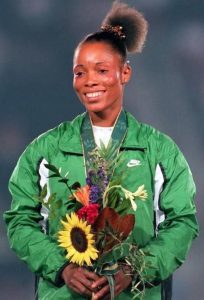 Nigeria’s first individual Olympic gold medallist is now eligible to return to athletics after the AIU reduced her lifetime suspension imposed in 2003, but the original doping conviction remains intact.
Chioma Ajunwa-Opara, Nigeria’s first individual Olympic gold medallist, is free to return to athletics after the Athletics Integrity Unit (AIU) reduced her lifetime ban to time already served, more than 23 years after her second doping violation.
In a decision dated November 18, 2026, in Monaco, the AIU granted Ajunwa’s application for a reduction of her sanction under the principle of lex mitior, which allows a more lenient penalty under subsequent rules to be applied retrospectively.
However, the decision does not exonerate the Atlanta 1996 Olympic long jump champion or overturn the original finding of a doping violation. Both anti-doping violations remain on her record, while the disqualification of results from the relevant period also stands.
Ajunwa’s lifetime ban followed an adverse analytical finding for nandrolone, an anabolic steroid, in a urine sample she provided during competition at the Athens Grand Prix Tsiklitiria on June 10, 2002.
On February 3, 2003, the then International Association of Athletics Federations (IAAF) recorded the Athletics Federation of Nigeria’s decision finding her guilty of a second anti-doping rule violation and imposing a lifetime ban under Rule 60.2(a)(ii) of the 2002-2003 IAAF Competition Rules. No appeal was lodged at the time.
Her first violation involved methandienone, following a sample collected on June 11, 1992. She served a four-year suspension before returning to competition and winning Olympic long jump gold in Atlanta in 1996.
The latest decision followed an application submitted on August 28, 2026, through her representative, seeking the removal of the lifetime ban.
The AIU considered the application under the World Athletics Anti-Doping Rules that came into force on January 1, 2026. The provisions allow athletes still serving sanctions imposed under previous regulations to seek a reduction where the current rules would have resulted in a lighter punishment.
Under the 2002-2003 regulations, a second violation involving a substance such as nandrolone attracted an automatic lifetime ban. The current rules, however, prescribe a different calculation for repeat violations.
For nandrolone, classified as a non-specified substance, the standard period of ineligibility for a first violation is four years. Applying the current regulations to Ajunwa’s case, the AIU calculated that the appropriate sanction for her second violation would have been eight years.
Having already served more than 23 years since the collection of the 2002 sample, Ajunwa has exceeded the equivalent eight-year suspension under the current rules.
The AIU consequently reduced her lifetime ban to time served, making her immediately eligible to return to athletics.
The decision will be publicly reported in accordance with Rule 8.5.6(b) of the Anti-Doping Rules. Copies were also sent to Ajunwa, her national federation, the Nigerian National Anti-Doping Committee and the World Anti-Doping Agency, which have rights of appeal under Rule 13.2.
Although the ruling does not erase her doping record, it removes the remaining restrictions associated with her lifetime suspension.
At 55, the decision does not necessarily signal a return to competitive long jump. Rather, it restores her eligibility to participate fully in athletics, including holding official positions, coaching and receiving accreditation at World Athletics events.
Beyond her Olympic achievement, Ajunwa also has a unique place in Nigerian sporting history. She was a member of the Super Falcons squad at the inaugural FIFA Women’s World Cup in China in 1991, making her the only woman to have represented Nigeria at a Women’s World Cup in football and won an individual Olympic gold medal in athletics.
She later served in the Nigeria Police Force, retiring in 2023 with the rank of Deputy Commissioner of Police.