Nigeria’s Medal Haul Hits 20-Year Low at African Senior Athletics Championships
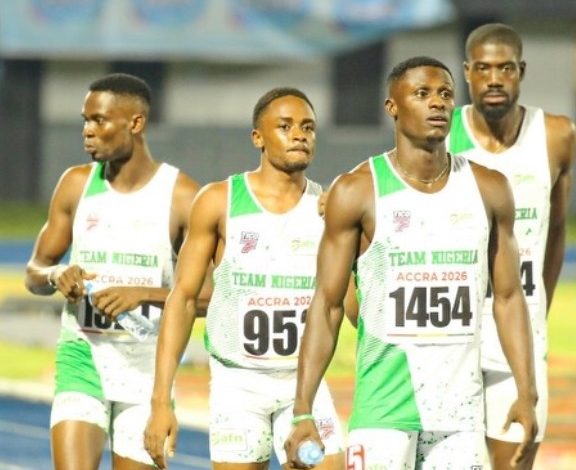
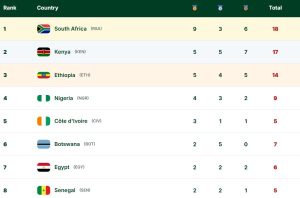 Nigeria’s disastrous showing at the 24th African Senior Athletics Championships in Accra, where the team finished fourth on the medal table with just nine medals and four golds, has been described as the worst in 20 years.
The outcome not only underscores the decline of Nigerian athletics but also mirrors the unwanted record set under the Tonobok Okowa-led Athletics Federation of Nigeria (AFN) board at the World Championships, where Nigeria failed to qualify a single relay team for the first time in history.
The gold medals in Accra came from one individual event and three relays.
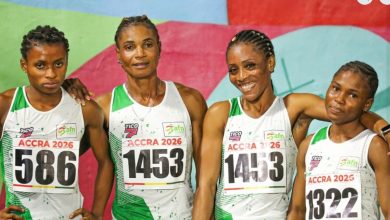
World 100m hurdles record holder Tobi Amusan secured Nigeria’s lone individual gold, her third since debuting in 2018, while the mixed 4x400m, women’s 4x100m, and women’s 4x400m teams delivered the remaining titles.
Yet Nigeria failed to capitalize on the absence of top stars from other African nations, missing out on gold in the men’s and women’s 100m, 200m, and 400m events.
The men’s sprint drought continues, with the 100m last won in 2008 by Olusoji Fasuba, the 200m last claimed by Uche Emedolu in 2006, and the 400m last secured by Clement Chukwu in 1998.
The women’s sprints tell a similar story, with Blessing Okagbare’s 2014 triumph the last in the 100m, Gloria Asumnu’s 2012 victory the last in the 200m, and Folashade Abugan’s 2014 win the only success in the 400m since Falilat Ogunkoya’s 1998 title.
Beyond the track, Nigeria’s athletics faces systemic issues. Stakeholders point to the lack of competition for home-based athletes and inadequate welfare. Athletes who competed in the AFN Golden League in April are still awaiting prize money payments, a situation that has further eroded trust in the federation.
Governance problems compound the crisis. The election that brought in the current AFN board has been described as fraught with irregularities and flagrant violations of the AFN Constitution, with individuals not eligible by nomination or co-option occupying board positions.
Allegations of athletes with multiple dates of birth being allowed to compete at the African U18 and U20 Championships in Abeokuta last year have also drawn scrutiny.
The matter is currently before the Athletics Integrity Unit (AIU), with a decision expected before the World U20 Championships.
Many stakeholders believe this is the worst AFN board in history, surpassing even the troubled tenure of Solomon Ogba.
Nigeria’s failure in Accra, coupled with governance scandals and welfare neglect, paints a grim picture of a federation in disarray and a sport in urgent need of reform.