Race Analysis: How Amusan Missed a Chance to Make Commonwealth Games History
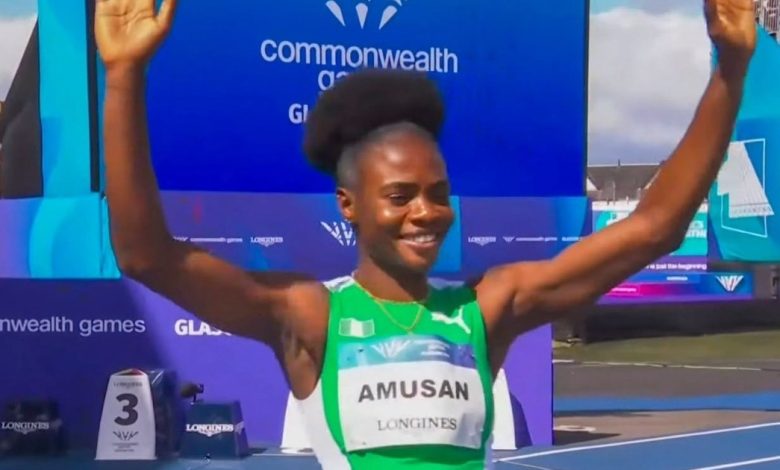
 Tobi Amusan arrived at the Glasgow 2026 Commonwealth Games with history firmly within her grasp. Victory in the women’s 100m hurdles final would have made the Nigerian the first athlete to win three consecutive Commonwealth titles in the event, adding to the gold medals she claimed in Gold Coast 2018 and Birmingham 2022.
Instead, the world record holder had to settle for bronze after clocking 12.60 seconds, finishing behind Bahamas’ Devynne Charlton (12.33) and Jamaica’s Megan Simmonds (12.41).
The result raises an obvious question: How did an athlete who has run 12.28 seconds three times this season and owns the world record of 12.12 fail to win?
The answer lies almost entirely in her start.
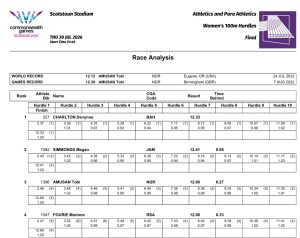
Amusan was already playing catch-up after the gun. Charlton reached the first hurdle in 2.37 seconds, while Amusan took 2.46 seconds, a deficit of nine hundredths of a second before the race had truly settled. By hurdle two, the gap had grown to 0.10 seconds (3.38 to 3.48), leaving the Nigerian chasing the Bahamian throughout the race.
Charlton maintained her advantage with remarkable consistency. From hurdles three to 10, she produced smooth, efficient hurdle intervals, never allowing Amusan to mount a serious comeback.
The Bahamian’s rhythm remained almost flawless, with splits consistently between 0.93 and 1.02 seconds, while Amusan’s hurdle-to-hurdle times hovered between 0.95 and 1.01 seconds. Those marginal differences, accumulated over ten barriers, proved decisive.
Interestingly, Amusan’s finish was almost identical to Charlton’s. Charlton covered the run-in from the final hurdle to the finish in 1.24 seconds, while Amusan took 1.25 seconds. The race was therefore not lost in the closing metres, it was lost in the opening 20 metres.
The splits show that Amusan never occupied a position higher than fourth over the opening two hurdles. She climbed to third by the third hurdle and remained there for the rest of the race, but by then Charlton had established control.
The defeat also continued a fascinating rivalry between the two fastest hurdlers of recent seasons.
It was Charlton’s second victory over Amusan in their five meetings in 2026, although the Nigerian still holds the overall advantage, having won 28 of their 35 career head-to-head contests.
Another factor may have been championship timing. Amusan’s season-best of 12.28 demonstrates she remains capable of world-leading performances but reproducing that level in a championship final is different from achieving it on the Diamond League circuit.
Glasgow’s final lacked the explosive start that characterised her fastest races this year.
Charlton, on the other hand, executed her race plan perfectly. She attacked aggressively from the blocks, established an early lead, and never gave the field an opportunity to reel her in.
Her winning time of 12.33 was only 0.03 seconds outside Amusan’s Commonwealth Games record of 12.30 set in Birmingham four years ago.
For Amusan, the bronze medal still adds another major championship podium to an already glittering career, but it also represents a missed opportunity.
A third consecutive Commonwealth title would have further cemented her status as the greatest women’s sprint hurdler in Games history.
Instead, Glasgow 2026 will be remembered as the night an uncharacteristically slow start denied the world record holder a place in the Commonwealth record books, while Charlton once again showed that in championship racing, execution often matters more than season’s bests.