Victor Okorie: Ogazi’s 43.38 Reveals A Different Kind Of 400m Runner
AFN Performance Director explains why Nigeria’s quarter-miler could have even greater potential
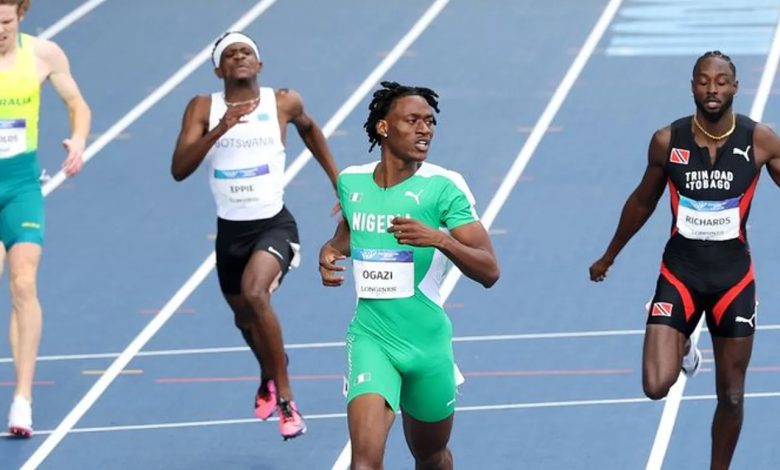
Athletics Federation of Nigeria (AFN) Performance Director and Athletes Liaison Victor Okorie believes Samuel Ogazi’s 43.38 seconds personal best over 400m could be an indication that the Nigerian has qualities that extend beyond what his 200m personal best currently suggests.
Ogazi, 20, has run 20.54 seconds for 200m but has already established himself as one of the world’s fastest quarter-milers with his 43.38 clocking. For Okorie, the combination is particularly intriguing because while 200m speed and 400m ability are closely related, they are not the same thing.
A fast 200m time provides evidence of an athlete’s raw speed, but the 400m demands much more than speed. Speed endurance, strength, efficiency, rhythm, relaxation, race distribution and the ability to resist fatigue over the final 100 metres can determine how effectively an athlete converts speed into a world-class 400m performance.
‘Samuel Ogazi’s story in the 400m is only beginning,’ Okorie said. ‘When I look at his 43.38 personal best, I don’t just see a very fast quarter-miler. I see an athlete whose 400m performance may be telling us something his 200m personal best has not yet revealed.’
The AFN Performance Director pointed to the history of the event to illustrate his argument.
Butch Reynolds ran 20.46 seconds for 200m and 43.29 for 400m, while Jeremy Wariner produced a 43.45 personal best despite running 20.19 for 200m. Grenada’s Kirani James never broke 20 seconds for 200m but ran 43.74 for 400m and went on to win Olympic and World Championship gold, silver and bronze medals.
Botswana’s Collen Kebinatshipi provides another interesting example. The reigning world champion has a 200m personal best of 20.08, but his 100m best is 10.89, demonstrating that exceptional one-lap ability does not necessarily require the profile of a traditional short sprinter.
‘These examples show that there are different roads to 43 seconds,’ Okorie said. ‘Some athletes arrive with extraordinary 200m speed. Others arrive through exceptional speed endurance and the ability to carry velocity over the final 200m.’
He stressed, however, that the relationship between the events should not be misunderstood.
‘200m speed and 400m ability are not completely separate,’ Okorie said. ‘Raw speed matters. Generally, the faster you are over 200m, the greater the potential ceiling can be over 400m. But being fast over 200m does not automatically make you a great 400m runner. You have to be able to convert that speed through endurance, strength, efficiency and race execution.’
That distinction, according to Okorie, is what makes Ogazi particularly fascinating.
The Nigerian has already produced a 43.38 performance despite a 20.54 200m best, suggesting that his ability to maintain speed over one lap is already highly developed. If he can improve his short sprint speed while maintaining those 400m qualities, his potential could become even greater.
‘Now imagine if he takes his 200m from 20.54 towards 20.1-20.2, while preserving the exceptional 400m qualities that have already taken him to 43.38,’ Okorie said. ‘That could be a very special combination.’
Okorie cautioned, however, against automatically translating a potential improvement in Ogazi’s 200m into a prediction of 43.00.
‘Running 20.1 does not automatically make someone a 43.00 runner,’ he said. ‘The 400m requires much more, strength, speed endurance, efficiency, race execution, health, experience and the ability to put everything together on the right day.’
The history of the world record also illustrates the different ways athletes can reach the highest level. Butch Reynolds ran 43.29 in 1988 before Michael Johnson lowered the mark to 43.18 in 1999. Wayde van Niekerk then produced the historic 43.03 at the 2016 Olympic Games in Rio.
Johnson and van Niekerk possessed extraordinary 200m speed, with personal bests of 19.32 and 19.84 respectively. Ogazi is developing from a different starting point.
That does not mean the Nigerian will necessarily follow the same path or eventually challenge van Niekerk’s 43.03 world record. Okorie believes such predictions must be treated with caution.
‘Could he eventually challenge the 43.03 world record? That is a huge mountain to climb, and we should remain humble about such a possibility,’ he said. ‘But I believe Ogazi has the talent and the profile to potentially challenge the very best in the world. Why not dream?’
For Okorie, the comparisons with past champions are ultimately less important than Ogazi’s own development.
‘I am not saying Samuel Ogazi will become the next Butch Reynolds, Michael Johnson or Wayde van Niekerk. He has to become Samuel Ogazi,’ he said.
‘At just 20 years old, he has already run 43.38, and his best 400m may still be ahead of him.’